Most retirement calculators assume that market returns follow a normal distribution - the familiar bell curve. It is a clean assumption. It makes the math easy. And it is wrong in exactly the way that matters most for retirement planning.
The bell curve says that extreme market events - crashes of 30% or more, rallies of 40% in a single year - are so rare they are essentially impossible. The 2008 financial crisis, under Gaussian assumptions, was roughly a 5-sigma event: something that should happen once every 14,000 years. The 1987 crash was even more extreme statistically. Both happened within a single generation.
This is what statisticians mean by "fat tails." The real distribution of returns has more probability mass in the extremes than a bell curve predicts. Crashes are more frequent. So are booms. The middle is thinner, the edges are fatter.
For retirement planning, this distinction is not academic. It is the difference between a plan that looks safe and one that actually is.
What Fat Tails Look Like in Practice
Under a normal distribution with a mean annual return of 8% and standard deviation of 16% (roughly typical for U.S. equities), a single-year loss of 30% or worse has a probability of about 0.9%. That is roughly once every 110 years.
Under a Student's t-distribution with the same mean and spread but heavier tails (say, 5 degrees of freedom), that same 30% loss has a probability closer to 3-4%. Once every 25-30 years. Which matches the historical record far better: 1929, 1974, 2000-2002, 2008, 2020.
The difference between "once a century" and "once a generation" is enormous when you are planning a 30-year retirement. A plan that survives the bell curve's version of risk may not survive reality's version.
Why This Matters More in Retirement Than Accumulation
During your working years, a fat-tail crash is painful but recoverable. You keep contributing, you buy at lower prices, and you have decades for the portfolio to recover.
In retirement, a fat-tail crash combines with withdrawals to create permanent damage. This is the sequence-of-returns risk problem amplified. A "once in 14,000 years" event that your calculator says you can ignore turns out to happen during your first decade of retirement, and suddenly your 92% success rate was a fantasy.
The danger is not just that crashes happen more often than expected. It is that the crashes are larger than expected. A normal distribution says "the worst plausible year might be -25%." Fat tails say "you should plan for -35% to -45%, because it has happened before and it will happen again."
Kurtosis: The Number That Measures the Problem
The technical measure of tail thickness is kurtosis. A normal distribution has a kurtosis of 3 (sometimes reported as "excess kurtosis" of 0). U.S. equity returns historically show excess kurtosis between 1 and 5, depending on the measurement period and frequency.
Higher kurtosis means more of the distribution's variance comes from extreme events rather than typical fluctuations. For a retirement portfolio, this translates directly to: the bad scenarios are worse than you think, and they happen more often than you think.
You do not need to memorize the math. You just need to know that if your retirement calculator assumes kurtosis of 3, it is lying to you about tail risk.
How Fat-Tail Modeling Changes Your Results
When you switch from a normal distribution to a fat-tailed one in this kind of simulation, several things happen:
Success rates drop. A plan that shows 95% success under Gaussian assumptions might show 85-88% under a Student's t with 5 degrees of freedom. The plan did not get worse. The assessment got more honest.
The worst-case scenarios get worse. The bottom 5th percentile of outcomes shifts meaningfully downward. Your "bad but survivable" scenario becomes "potentially catastrophic."
Conservative strategies look more valuable. Under a bell curve, the difference between a fixed withdrawal and a guardrails strategy might be 5 percentage points of success rate. Under fat tails, that gap widens to 10-15 points, because flexible spending provides more protection against extreme drawdowns.
Diversification benefits shrink. Fat-tail events tend to affect multiple asset classes simultaneously. Correlations spike during crises - stocks, corporate bonds, and real estate all drop together. A Monte Carlo model that uses a correlation matrix with Cholesky decomposition can capture this, but only if the underlying return distributions are also fat-tailed.
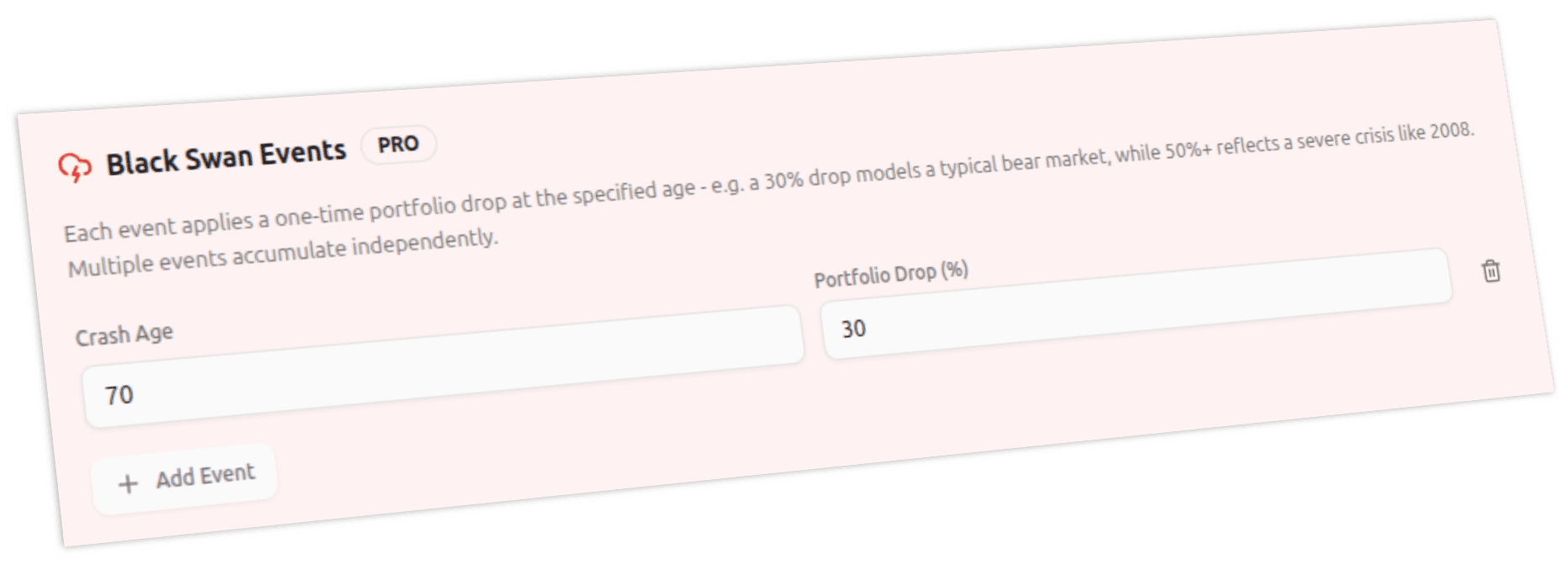
The Honest Assessment
There is an uncomfortable truth in all of this: fat-tail modeling makes retirement planning look harder and less certain than most people want to hear. That is precisely why it matters.
A retirement calculator that uses a normal distribution will show you optimistic success rates. You will feel confident. You might retire earlier or spend more freely than you should. And then when the next black swan event arrives - and it will - you will have no margin for error.
A calculator that uses fat tails will show you lower success rates. That is not pessimism. It is realism. And realism is what gives you the chance to adjust your plan before the market forces you to.
The 2008 crisis did not catch mathematical models off guard because it was unimaginable. It caught them off guard because they were using the wrong distribution. The data for fat tails has been available for decades. Benoit Mandelbrot wrote about it in the 1960s. The models just chose to ignore it because the bell curve was simpler.
Your retirement is not a place for simplifying assumptions about risk.